Tuesday, July 07, 2015

My contributions to #Transacting: A Market of Values

For #Transacting: A Market of Values, brought to you by the tireless collective labour of Critical Practice, I shall be making two contributions. The first will be a short talk at a Speakers’ Corner constructed for the day. I will be talking about my emergent thoughts on image economies at 12.45. 
Throughout the day I will be running a stall titled Speculative values: Science Fiction Short Stories.
The event is in the Parade Ground on Saturday 11th July 2015, 1-5, at Chelsea College of Arts, next to Tate Britain, 16 John Islip Street SW1P 4JU.

Speculative values: Science Fiction Short Stories

Value is so often determined according to the social and economic conditions of a seemingly continuous present. To question accepted notions of value, I will read a selection of science fiction short stories at hourly intervals throughout the duration of the Market. The stories have been chosen for their sense of cognitive estrangement, and for their engagement with ideas related to value. Value is offered as something contingent, that can be imagined as otherwise, as a set of alternatives not determined by the social and economic conditions of the present. The readings will be offered to an audience, but not for free. In return, the audience must listen, think and engage, providing reciprocity through discussion.

Schedule

1.15pm - The Ones Who Walk Away from Omelas by Ursula K. Le Guin
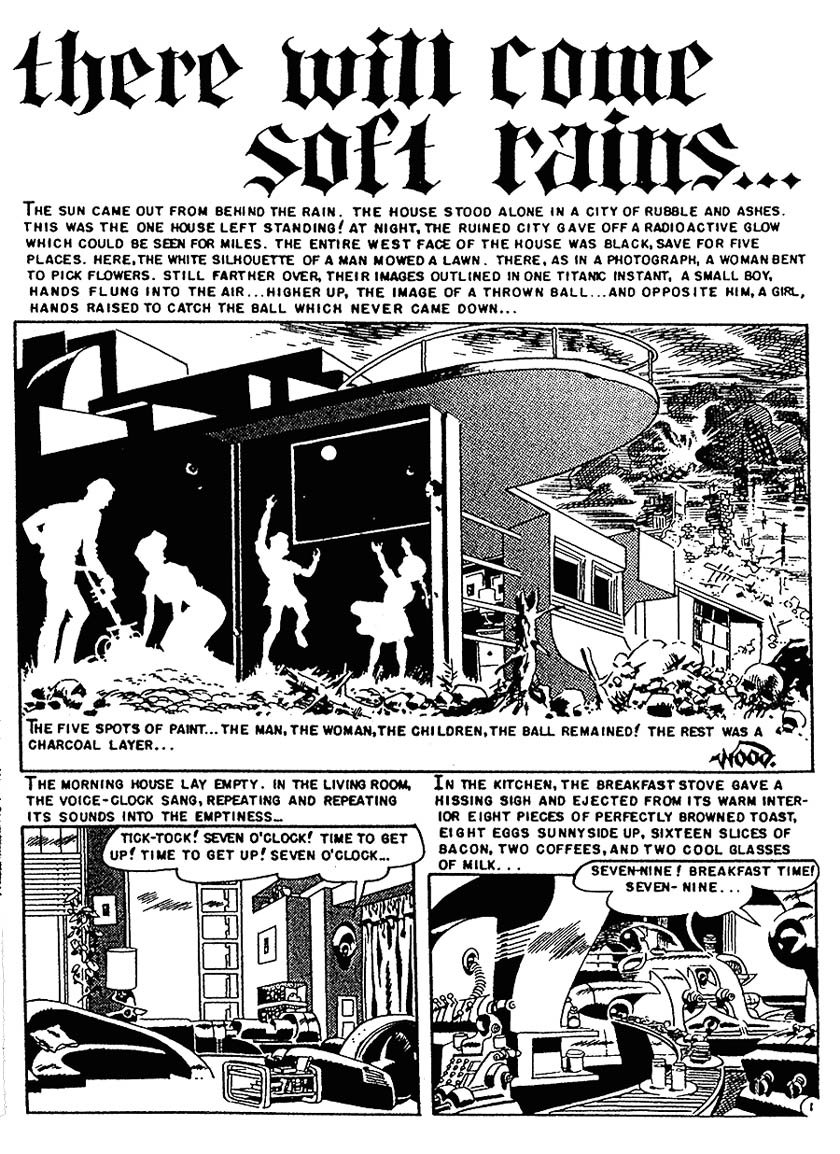
2.15pm - There Will Come Soft Rains by Ray Bradbury
3.15pm - When it Changed by Joanna Russ
4.15pm - Branded by Lauren Beukes

If you would like to read the stories in advance of my readings, They are available here. 


Tuesday, August 19, 2014


Uncanny returns of the horror comic in the work of Hannah Berry and Gareth Brookes.

A paper given at the 5th International Graphic Novels and Comics Conference, The British Library London. 

As forms of genre horror become ever more mainstream in Western popular culture, there is an increasing move away from forms of disturbing estrangement in favour of either a playing out of anxieties and the reinforcement of normative attitudes and expectations, or towards ironic reflection. Clever and funny but not scary. These are generalisations, but nevertheless, these appear to be the dominant tendencies. 

I won’t attempt a historical context of anglophone horror comics, but it is a tradition that I find engaging. I tend to imagine a historical trajectory in the US, from pre code horror, to the re-emergence of horror themes in mainstream Marvel and DC titles, and the in the Warren titles (Creepy and Eerie.) while we had Misty and Scream in the UK,  through to recent explorations of horror themes in the work of artists such as Charles Burns and Becky Cloonan. 
I belong to a generation that aged with the comics. I read comics for kids, which became increasing aimed at older audiences. So those horror comics aged too.I was 12 when I discovered Swamp Thing, with the headline “Sophisticated Suspense” above the title, and no Comics Code Authority stamp. It went on to carry the promising warning For Mature Readers on the cover. These elements certainly helped to hook me as a reader, although it was Alan Moore’s name that hooked me too, as I had long since been a 2000AD and Warrior reader. But those days of kids reading comics, the 70s and 80s, are long gone, and We can only revisit those supposedly subversive pre code days with imaginary nostalgia for the young audience who devoured them in the early 1950s. 

So, instead, I’d like to think about some things that might be thought of as contemporary horror comics, through Adamtine by Hannah Berry, and The Black Project, by Gareth Brookes. I’d like to talk about them as horror comics, and to think about what this might mean. Berry and Brookes offer strange, powerful and affecting returns for the presence of horror within anglophone comics. They recover the ability to disrupt the smooth surfaces of social reality.

So how do these books disrupt the surface of reality? How do they achieve a sense of discomfort, unease or dread? I would like to suggest that both Adamtine and The Black Project engage with what we can call the uncanny. These are distinct yet related manifestations of horror as something affecting, and as tied to forms of aesthetic experience, namely the uncanny, and connected to subversive possibilities of horror as a form of contemporary surrealism. 

Berry plays on notions of doubling of the self, of the idea of the stranger, all taking place on that great space of modernity, the railway. The uncanny is present in the familiar locations, in domestic settings, offices, train stations.  These spaces form the background for the carefully put together narrative, which demands attentive and close reading. It is very much in the tradition of powerful and concise short stories. Berry’s work is long enough to immerse readers into her world of dread and unease to which every panel adds, without diluting the narrative with unnecessary elements. 

Anthony Vidler, in his book The Architectural Uncanny, writes “The contemporary sensibility that sees the uncanny erupt in empty parking lots around abandoned or run-down shopping malls, in the screened trompe l’oeil of simulated space, in, that is, the wasted margins and surface appearances of postindustrial culture, this sensibility has its roots and draws its commonplaces from a long but essentially modern tradition. Its apparently benign and utterly ordinary loci, its domestic and slightly tawdry settings, its ready exploitation as the frisson of an already jaded public, all mark it out clearly as the heir to a feeling of unease first identified in the late eighteenth century.” (Vidler p.3)

Vidler argues that this a domesticated outgrowth of the sublime, terror to be experienced in the comfort of the home. It is detectable in the tales of Poe and E.T.A. Hoffman. The motifs included the invasion of familiar spaces with alien presences and plays upon the doubling of the self. Vidler discusses this in terms of class insecurity, a bourgeois kind of fear. The comfortable setting in which these stories take place is itself brought into a degree of insecurity. It is an urban form of fear, arising together with new metropolitan spaces, transformed and intensified in Western culture by the terrible destruction of the World Wars. It emerges within Avant Garde practices as an instrument of defamiliarization, “as if a (Vidler says) world estranged and distanced from its own nature could only be recalled to itself by shock, by the effects of things deliberately “made strange.” (Vidler 8) This is the uncanny as an aesthetic category, as the “sign of modernism’s propensity for shock and disturbance.” (Vidler 8)
Berry uses a consistent formal device to structure her narrative. The story’s present is made up of rows of four panels arranged on black pages. Flashbacks to the recent past are made up of three panels on a white page. Without this separation, we would be lost in the changes between then and now, the subtlety of the narrative would shift from unsettling ambiguity to illegibility. Berry also makes use of the black of the page to indicate the presence of what we can think of as the book’s monster, a blackness that is a supernatural force of righteous and unyielding judgement. 

We can also see here how the stable rows of panels are also occasionally disrupted. Such as this moment where one tall panel takes up all four rows in a flashback, a full length figure in a train toilet, staring down at the sink, ignoring his double in the mirror, then confronting it.

The image recurs towards the end of the book, when the identity of the protagonist, and his role in the overall story, is revealed. Over these two pages, we finally comprehend how he fits in to a cycle of bad decisions and unyielding punishment. The contrast between the two full length images, each of which is dotted below by an image of a mobile phone, to form a giant exclamation mark, generates a feeling of panic and confusion. My eye is drawn across the page in a frenetic jumble. The panels are much smaller than we are used to on the other pages, and they run down in two vertical columns on either side of a large panel, which reads as tall. The images are fragmentary, generating a sense of shock in the reader, and convincingly associating our confusion with the shock of the protagonist as he takes in the scene before him, piecing together the meaning of these fragments as we do, while the tall panels allow us to piece together the meaning of his decision. It is powerful and unsettling. These pages also play on doubling. There is doubling through repetition, through reflection. Through realisation, clues, lingering presences. 
The narrative of The Black Project is also set against banal and familiar spaces, but rendered in a very different formal approach. The book has been made through a combination of lino prints and embroidery, achieving a unique visual sensibility. These techniques are used to depict strange and resonant images of nostalgic spaces, reinforcing the sense that adult readers are immersed in a world of childhood. The setting could be many places in suburban Britain in the latter part of the twentieth century, in a time before mobile phones and the internet. It is a world of net curtains and bad tv. 
The Black Project focuses on Richard, a boy growing up in a dull suburban environment. His exact age is not disclosed, but he is somewhere between childhood and the more developed sexuality of an average teenager, in an uncomfortable hinterland where he is unable to talk openly about his desires. Alienated from the boring world of adults and from his own peers, he turns to a self created world of comfort and intimacy by making a series of girlfriends. The story follows his attempts to create and preserve a companion in the face of constant adversity. The great adversity faced here is the risk of discovery.

In The Black Project, we recognise the presence of Hans Bellmer’s poupees. This associate of the Surrealists constructed sexualised life sized dolls that still have a power to unsettle and disturb. The poupées were in part inspired by E.T.A Hoffman’s The Sandman, the story that is engaged with in some detail in Freud’s essay on the uncanny. 

For Bellmer, these dolls were explicitly concerned with seduction and perversion, but also with the psychic shattering of the male subject. The eroticism was not just located within himself, but in the dolls, as if they were thinking and feeling subjects. This is the sense that is conveyed in the boy’s projection onto his dolls as actual girlfriends, not as dolls or substitutes. (Brookes has also shown versions of some of the dolls that Richard builds at the London Print Studio (2013) which reinforce the connection to Bellmer’s Poupees. ) For Belmer, these were representations for an adult to reflect upon nostalgia for adolescent desire. However, his dolls are also sites of resistance. In 1933, when the Nazi’s took power in Germany, he made the decision to give up any work that could be made useful to the state, however indirectly. This meant rejecting his background in engineering, and the beginnings of a career in design and illustration, which then led to his creation of the dolls. The poupées were made of wood, metal and plaster, with large ball joints making them infinitely posable. The dolls were photographed, and the original form of Bellmer’s doll work was a small self published book. The book contained ten photographs of the dolls, and a short text in which he speaks of his desire to recover “the enchanted garden” of childhood. (Foster 103) (He then published a set of eighteen images in the surrealist magazine Minotaure (Winter 1934-35) Foster then says that in a later text, “he locates desire specifically in the bodily detail, which is only real for him if desire renders it artificial - that is, if it is fetishised, sexually displaced and libidinally overvalued. Such is the “monstrous dictionary of the image”.  (Foster 103) Foster argues that there is more to Bellmer than fetishism. These are not fixed but mobile configurations of desire. These are like sentences to be rearranged. Bellmer, he argues was making representations of mastery and control, but he also claimed he wanted to help people, to assist in their coming to terms with their instincts. Foster discusses this in relation to writings by Georges Bataille. (Foster 113) For Bataille, art’s origins in prehistory, and its childhood formations, are concerned not with resemblance, but by altération. This term refers to the formation of an image by its de-formation. And perhaps this is what Brookes is concerned with, both in terms of narrative content and the pictorial forms he employs. Might The Black Project be a process of de-formation?

There is a specific historical context in which Bellmer’s dolls are situated. Foster looks at them as the embodiment of Bellmer’s rejection of the Nazis, his resistance to them. They are attacks on the state, and upon his authoritarian father who embraced Nazi rule. Foster argues that Bellmer attacks Nazism through contesting the construction of normative masculinity with elements that the regime despised. The fascist body fears dissolution and otherness. Bellmer’s dolls posit a feminine with the construction of male desire. The fear of destruction and diffusion in fascist body imagery is manifested in the poupees. There are liberatory intentions in the critical exploitation of sexist fantasy and objectification. The dolls in The Black Project lacks the oppressive context of Bellmer’s dolls. But Foster argues that there is a primary surrealist politics: “to oppose to the capitalist rationalization of the objective world the capitalist irrationationalization of the subjective world.” (Foster 130) What a simple and effective way to remind ourselves of the subversive value of horror. Horror comics oppose the rationalisation of society with the irrational world of the subject. 
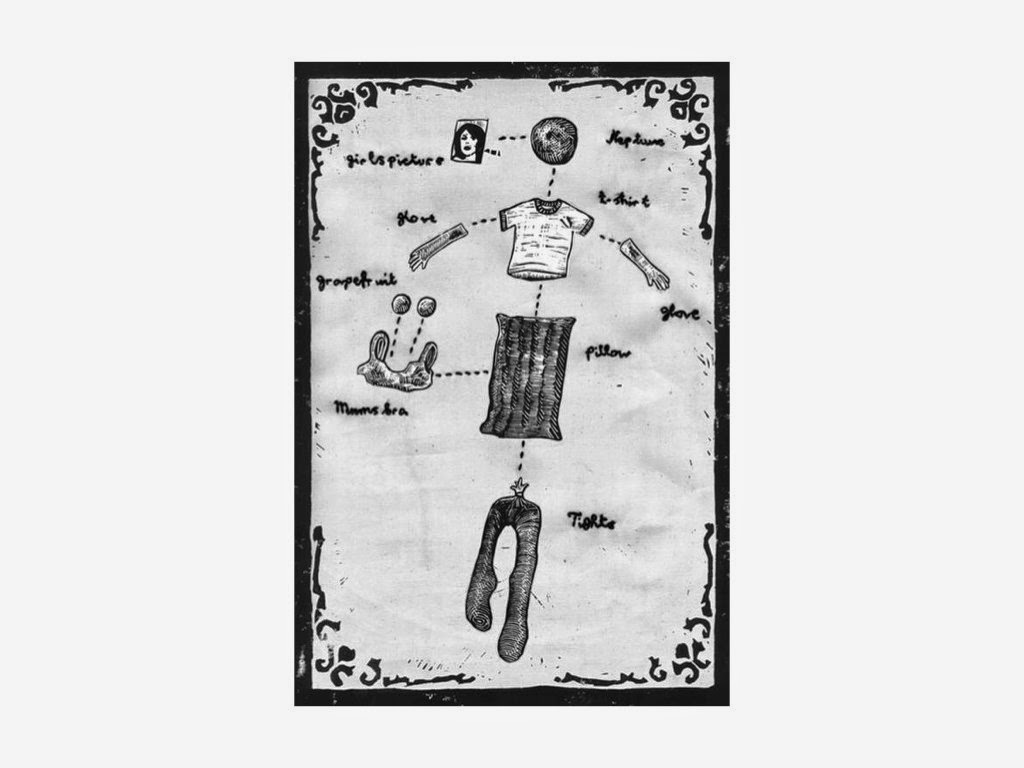

There emerges a potential for these new horror comics to attack the normative frameworks of the expectations and demands of liberal democracy and capitalism. Can the uncanny question conventional and oppressive structures that enable class distinction and inequality? Does this kind of horror subvert social and economic repression? 

Bellmer’s take on uncanny figuration is also included in a project by the artist Mike Kelley, whose exhibition and book The Uncanny developed from the collaborative work Heidi: Midlife Crisis Trauma Centre and Negative Media Engram Abreaction Release Zone, made with Paul McCarthy in Vienna in 1992. 

Kelley began collecting images of figurative sculptures that possessed qualities he was interested in duplicating. When he was approached to make a work for the sculpture exhibition Sonsbeek 93 in Arnhem, Holland, he suggested an exhibition within the exhibition based on this collection of images. As the project developed, Kelley took his curatorial role seriously, leading to an accompanying catalogue, complete with his essay 'Playing with Dead Things: On the Uncanny', which was to become an influential text in the field of contemporary art. The exhibition has since been remounted in a larger form at Tate Liverpool in 2004, and an expanded catalogue produced. 

In his essay, he makes it clear that the “uncanny is apprehended as a physical sensation” (26) in the manner he associated with an experience of artworks. He thinks back to childhood, to unrecallable memories of a confrontation between a ‘me’ and an ’it’, where the distinction between the two becomes confused. He says that these feelings “are provoked by an object, a dead object that has a life of its own, a life that is somehow dependent on you, and is intimately connected in some secret manner to your life.” (26) 

He discusses Freud’s essay of 1919, writing that Freud distinguishes between the uncanny and the fearful in that the uncanny is associated with the bringing to life of what was hidden, bringing us back to something familiar. Freud cites Ernst Jentsch’s location of the uncanny in doubts as to whether or not a thing is alive, the possibility that a lifeless thing in fact being animate. He lists wax works, dolls and automatons among the objects that produce uncanny feelings. Kelley describes being struck by this, and how it corresponded to trends in art at the time of his first reading of the essay in the mid 1980s. And Among the images he compiles is Oskar Kokoschka’s doll of Alma Mahler, a fetish object that for years served as the focus of his desire, before it was discarded by Kokoschka and torn apart by guests at a party. However, Kelley tells his own version of the uncanny. He refers to, but deviates from Freud’s essay ‘The Uncanny’. Freud’s uncanny is not about lifelike objects, but about the return of the repressed, which is more the territory of Adamtine. Berry attacks a visual regime in which everything is depicted clearly, and fully explained, with no room for doubt or ambiguity, where we see everything constantly. Brookes is taking apart constructions of subjectivity and desire. The Black Project opposes stable forms of subjectivity often found in popular culture, while returning to the unstable manifestations of subjectivity often found within horror comics as a tradition. Just as Bellmer’s dolls expose fascist imagery, Brookes offers a similar exposure of our own culture of perfection and gendered fixity.

Both works are unflinching in forcing us to confront our own uncertain desires. These reinventions of horror comics reposition horror as a source of critical and disruptive reading experiences. These are sites of powerful and engaging disturbances inhabited by readers. Might such disturbances be aligned to disruptions of normative subjectivity, moral certainty and the fixity of social order? 

In reconfiguring horror, they are able to disturb, performing a distancing and engaging form of alienation. Adamtine and The Black Project achieve their specific uncanny and disruptive power through an attentiveness to the narrative possibilities of the medium itself. They work towards a subversive alienating of the reader that has replaced the now lost value of comics as a corrupting influence upon the young.
Tuesday, April 26, 2011

Critical Surrealism in Nemesis The Warlock

We begin with an image of violence. The page is highly stylized, beautifully rendered, and embroidered with details. Although the image is mannered and exaggerated, there is a solidity to the drawing, a consequential materiality. There is a hardness to these lines, a severity which helps us to believe in the unrelenting cruelty of these villainous figures. In the corner is an illuminated text, grotesque in form, narrating a future perspective of a distant and dark history. We are shown a medieval future that has regressed into violence and dogma, into the worst that history has to offer: Intolerance, unthinking superstition, ignorance, brutality. However, I would like to suggest that the image also introduces an absorbed and reconfigured form of surrealism. It is given a new form within a space of mass culture. A powerful counternarrative within a branch of culture industry aimed at children. It is an uncanny reappearance of subversive and irrational forces that tap into a play of politicised aesthetics. The splash page that introduces Book 1 of Nemesis the Warlock, sets an intense tone that is to continue for the its entire run in the weekly anthology comic 2000AD over the course of the 1980s. 2000AD was a complicated site of escape for young readers. The future generally looked pretty bleak, but perhaps not much worse than the past or present. The origins of 2000AD are linked to the co-creator and writer of Nemesis the Warlock, Pat Mills. He was working in both an editorial and script writing role for the company IPC, who together with rival company D.C. Thomson, dominated the world of British comics in the 1970s. In 1976, prompted by the immanent release of a number of science fiction films, including Star Wars, Mills was instrumental in founding 2000AD and ensuring its initial survival at a time when the lifespan of a comic title was notoriously short. After abandoning his editorial role, he returned to the title as a writer, where he maintained a consistently adversarial and difficult relationship with paper’s management. While it is important to recognise that the commercial potential of science fiction, in the eyes of the publishers of the comic, was connected to the success of cinematic blockbusters, the terrain of science fiction that Mills and other creators responded to was one that had been transformed by the New Wave of British Science Fiction that had emerged from the pages of the magazine New Worlds in 1960s. This was an influence that I’d like to think was not limited to the textual content of the work that emerged from New Worlds, but that was also connected to emergent visual sensibilities.
In 1962, the traditional science fiction illustrations were dropped from the cover, opting instead for photographs of featured authors, and then in 1963 it lost cover images completely. 
Under Michael Moorcock, who became editor in 1964, not only was there a shift in the direction that the content took, towards the emerging experimental sensibilities of Aldiss Ballard and others. There was also a new graphic sensibility. By the turn of the 60s, this had further evolved into a form that was sensationalist, while retaining a critical edge that displayed borrowings from Pop and Surrealism.


What was happening to the covers on New Worlds also had a parallel in mainstream publishing. Earlier in the 1960s, under the art direction of Germano Facetti, Penguin introduced a new formula of reproducing a work of art on the cover of their Classics, Modern Classics, English Library and Science Fiction series. Upon his appointment as editor of the science fiction series in 1963, it was the suggestion of Brian Aldiss to use surrealist artists.

Here we see James Blish, A Case of Conscience, from 1953. Using a detail from The Eye of Silence (1943-44) by Max Ernst. The Dragon in the Sea, Frank Herbert, had Underwater Garden (1939) by Paul Klee. The Day it Rained Forever, a collection of Ray Bradbury short stories, with a detail from Garden Aeroplane Trap (1935) by Ernst.
Mission of Gravity, an work of ‘hard sf’, by Hal Clement, makes use of a detail from The Doubter (1937) by Yves Tanguy, and Olaf Stapledon’s Sirius, shows In the Land Called Precious Stone by Paul Klee.
The Penguin paperback edition of Ballard’s The Drowned World used Yves Tanguy’s Le Palais aux Rochers (The Palace of Windowed Rocks) (1942), the Crystal World Panther Edition of 1968 was given a cover by Ernst, a detail of The Eye of Silence (1944).
While the presence of Surrealism is explicitly alluded to by Ballard, and the presence of Surrealism in Ballard’s work has been explored in depth, notably by Jeanette Baxter, the Surrealist worlds of Aldiss have yet to be unpacked to the same extent. His short novel Earthworks (1965) , for example, is composed of an extraordinarily textured surrealist fabric. It begins with the image of a dead man floating across the sea, a spectre that is provided with a rational and materialist explanation, but that continues to haunt the protagonist as a series of neurotically produced visual ruptures in the surface of reality. The cadaver breaks up any remaining semblance of normativity that might sustain the psychic landscape, which is reflected in the breakdown of social and political order described in the near-future setting of the novel.  Aldiss is as much a builder of surrealist tainted worlds as Ballard, with perhaps an even greater sense of the visual, and a recognition of the need to make the correlations explicit. His recognition of the importance of aligning science fiction with Surrealism was more than  a cynical marketing strategy. It was an important part of manifesting the psychically and socially unstable terrain explored in science fiction.

The visual cultures of science fiction would continue to change. The use of Surrealist images in Britain gave way to a greater synthesis of elements in the generation of new imagery in line with pop-culture tendencies, with a convergence between book covers and album covers. 

The diffusion of surrealist tendencies was, of course, part of this broader set of trends. Covers such as this for Ballard’s The Wind from Nowhere, by Alan Aldridge, replaced appropriation with synthesis, modernist surrealism with a 60s graphic sensibility. We can see the emergence of new visual possibilities for science fiction.
In creating the universe of Nemesis the Warlock, Mills and O’Neill tapped into the current of Surrealism than ran through the emerging visual culture of science fiction.
Mills also tapped into a current of Surrealism in the pages of the French science fiction comic Metal Hurlant, He saw that audiences can be pushed into expecting more, and demanding more, from comics. First published in 1974, and co-founded by Moebius, Metal Hurlant was a space for experimenting with non linear narratives, while openly obsessed with eroticism, of various degrees of explicitness and weirdness.
It is clear that French comics, and Metal Hurlant in particular had an enormous influence on Mills, that ran parallel in his scripts with his translation of the dark and ambivalent tendencies of the New Wave of British Science Fiction. The roots of Nemesis the Warlock c an be found in the final episodes of the series Ro-Busters. These panels offered a starting point for the one off story Terror Tube. Mills and O’Neill were intrigued in particular by the possibility of creating different worlds, of the look, feel and setting of a story changing regularly. Implied here are forms of improvisation, of contrasting forms, of sensorial shocks. This took shape in the form of a new series for 2000AD called Comic Rock, which would tell stories supposedly connected in some form to popular songs. Mills and O’Neill provided the first of these, which was linked to The Jam’s Going Underground, which had been at number 1 a few months earlier. The Comic Rock idea, was for Mills, an opportunity to learn from Metal Hurlant directly. There is a deliberate leaning towards strangeness, towards pushing the boundaries of reader expectations and editorial instruction. 


The popularity of the world they created, and the mysterious, unseen character Nemesis, resulted in a two part-sequel, which was followed by the commissioning of a full series. The story focused on Earth in the distant future. This is a future that contains the outmoded, that appears disjointedly non-synchronous. The surface of the planet was a wasteland. Humanity had retreated within the Earth itself, carving out vast subterranean tunnels and caverns. Humanity had also regressed into a state of fear, prejudice, intolerance and superstition, while focusing their irrational fears upon the other, the impure and unclean. In short, the alien. 
The Earth, renamed Termight, was ruled by masked fanatics known as Terminators, under the leadership of Torquemada.  Nemesis led the resistance against this genocidal regime, which was dedicated to stamping out all alien life in the galaxy. 

Throughout Book 1, Mills and O’Neill test the boundaries of the episodic comic form. The structuring of narrative episodes in Book 1 is unconventional for its context in a British anthology comic in the early 80s. The first two episodes are concerned with the slaughter of innocent aliens, and the return of Torquemada, who was believed dead but now exists as a phantom, capable of possessing bodies. This is followed by a three issue narrative arc focusing on a small human community on a remote planet who discover Nemesis, injured and apparently helpless after he is shot down in his craft, the Blitzsphere. 
He is captured, offering no resistance, beaten, humiliated and hanged by the locals who hope to receive a reward. The story unfolds with mysterious and gruesome deaths befalling the villagers who captured Nemesis, playing out as an unsettling gothic western. 


The next issue offers another jolt, a convulsive shift in setting. We are in the tunnels of Termight,where we are introduced to Purity Brown, one of the rare female characters in 2000AD at the time. She and a bizarre looking human called Googly, are running for their lives, pursued by Terminators. They run down vertical surfaces, and cross the void that intersects two huge subterranean cities - Mausoleum and Necropolis. The two cities meet as opposing mirrored spires. Skyscrapers have evolved into stalactites, with little regard for gravity. These panels play with vertiginous and confusing spaces, inverting the everyday life of Termight.
Then we have an entire week’s storyline relating a meeting between Nemesis and his Great Uncle Baal, an old sorcerer who has been banished to a remote fringe world for his unethical experiments on humans. This is a realm of magic. Not the superstition of the Terminators, but genuine magic, dark, chaotic. 
After this, Book 1 follows a more conventional, action orientated path. As the popularity of each issue and story was measured by readers’ polls, it is likely that the focus on action that follows is due to editorial pressure. However, while it may be more conventional in the orientation towards violence and action, the rest of Book 1 is determined by an unusual temporality. Over 9 issues, the story focuses on the Feast of Zamarkand, the most important date in the ritualistic Termight calender, and the occasion for the ritual execution of their political prisoners. The executions of aliens and traitors are therefore of great symbolic importance, and their escape is of great importance to Nemesis due to its potential symbolic value. He hopes that news of a mass escape will rally neutral planets towards resistance against Termight’s murderous empire. But the setting of the Feast of Zamarkand also gives Mills and O’Neill license to develop the extreme and intoxicating strangeness of Termight.  As the ceremony begins, a panel shows a procession of terminators. It is a twisted vision of a Spanish Samanta Santa procession, of brotherhoods in their penitential robes and hoods. 
The Temple of Terminus is the most bizarre element in all of this, a nightmarish underworld. It is hellish. Architecture becomes figurative. Towering over the scene, emerging from flames and smoke, the spectre of Torquemada. Thanks to a spell cast by Nemesis, the flames of execution are transformed into a dimensional portal, allowing the prisoners to escape. 
The architecture, if we can call it that, seems increasingly visceral. Torquemada, inhabiting the bodies of recently dead terminators, also becomes more grotesque. 
Book 1 was shocking and innovative, turning the world of future humans into something hellish, casting humanity as demonic. It also established a solid connection with the theoretical readings of Surrealism offered by Hal Foster in Compulsive Beauty. The satyrical nature of the script, the visual doublings and shocks, the reveling in uncanniness, in distortion and excess, resonate with Fosters readings of Surrealism as compulsive and convulsive repetition, as destabilising, and in terms of unsettling desires. And at the end of Book 1, after Nemesis and the prisoners have escaped to a forbidden and forgotten subterranean level, we see another form of the outmoded and non-synchronous, identified as the ruins of Waterloo station, a relic from a long forgotten era. The relationship to Surrealism established by Mills and O’Neill can also be looked at through  Walter Benjamin’s 1929 essay, Surrealism: The Last Snapshot of the European Intelligentsia. In his text, he develops the term ‘profane illumination’. This is a perceptual transformation of the everyday into the uncanny and irrational. What is of particular interest here is the correlation to estrangement, to disorientation, defamiliarisation. In particular, profane illumination shares an affinity with Darko Suvin’s definition of science fiction as the literature of cognitive estrangement. 
The difference between Suvin’s Cognitive Estrangement and Benjamin’s Profane Illumination is one of the gap between criticism and action, between interpretation and agency. For Benjamin, this is in terms of a revolutionary potential within surrealism, but perhaps it can be usefully translated into political agency, into actually affecting change in the reader, and the reader affecting change in the world. And what we see play out in Book 1 is a politicized surrealism delivered to a mass audience of young readers.

Books 2 and 3 expand the universe and narrative possibilities of Nemesis the Warlock.
For book 2, drawing duties were taken over by Jesus Redondo. The intensity of O’Neill’s approach to drawing had led to deadline problems, whereas Redondo’s far more immediate style was produced at a rate that fitted the weekly schedule. O’Neill returned for Book 3, which is most notable for showing the world of the Warlocks, introducing in particular his baby son Thoth. 

And then came book 4, titled The Gothic Empire, which appeared to reinvent the visual and cognitive terrain of Nemesis of the Warlock. But the opening two issues are actually comprised of material that was originally created to be the first parts of Book 1. This was what Mills and O’Neill came up with when first exploring Nemesis as an ongoing series, through a free play of ideas between them, that they describe as jamming, but that might also be thought of as free association, as games of chance, a kind of narrative exquisite corpse of imagery and ideas and story fragments. 
But these early pages didn’t explain the universe of which they were a part, so they were put to one side until the story had caught up with them.
Although the Gothic Empire had been created by Mills and O’Neill, it was Bryan Talbot who really transformed these ideas into a narrative and carried Book 4 forward into new territory. These pages revel in a collapsed temporality.
The Gothic Empire focuses on an alien civilization who had been listening to Earth’s early radio broadcasts, which had radiated out into deep space. They recreate the British Empire in extreme detail, fixing their society upon a translated form of Victorian and Edwardian elements. Their own bodies are also transformed, as these aliens have the ability to modify their outward forms, to make themselves look almost human, to the extent that they consider themselves to be human. 
They are now at war with the Termight Empire, fighting for survival, never expecting that they would be considered alien and be attacked. The introduction of a these historical periods brings the future universe of Nemesis into a temporal intimacy with surrealism. 
We see the obsolescence of the Victorian. The bourgeois remnants of nineteenth century culture. 

There is a tension between old and new brought out by the members of The Hellfire Club, a secret society who intend to overthrow the old regime in favour of progress, fashion and reform, who base their ideas on broadcasts from Earth later in the C20.


Talbot’s imagery grows out of the worlds created by Grandville, a significant point of reference for Surrealists and for Walter Benjamin, 


He also pays homage to the proto science fiction of Albert Robida, while the use elaborate hatching and tone suggest something of an engraved feel.


The outmoded forms of illustration evoked are reminiscent of the collage narratives of Ernst, as are the qualities of uncanniness present in Talbot’s work on The Gothic Empire. Talbot continued working on Nemesis, producing some arresting imagery for Books 5 and 6, but book 7, which began in October 1987, introduced the work of John Hicklenton. He managed to follow O’Neill and Talbot with something unfamiliar, while somehow remaining consistent with what Mills had started at the beginning of the decade, with the unstable strangeness that lay at the core of these stories. 


Book 7, is set in 15th Century Spain. Thoth, the son of Nemesis, is travelling through time, killing all of the earlier incarnations of Torquemada, including Hitler, General Custer and Matthew Hopkins, the Witchfinder General. He has arrived in Spain to kill the original Thomas de Torquemada, the Grand Inquisitor. As a result of these assassinations, Torquemada, who now has a permanent body, has started to decay, to rot like a living corpse. The present is taken apart by removing pieces of history. Hicklenton offers another take on the outmoded and contamination. He gives us a glimpse of the past, contaminated by the evil of the future, which of course is just a mere reflection of extant religious authority and fanaticism.


He also imbues Nemesis himself with a genuine sense of strangeness and alterity. 
Hicklenton’s work on this period of Nemesis revitalised the strip while sustaining its core ideas. The narrative setting in the past also expands the non synchronous, the conflation of unstable temporalities that had been present in the strip from its early stages. 
The surrealist interest in the non-synchronous is addressed by Hal Foster through a reading of Ernst Bloch, and his work Heritage of Our Times. Foster cites Bloch’s discussion of the outmoded, and its contamination by fascist exploitation. The idea of a Now is an inconsistent now. There is no shared universal sense of Now. This is the essential factor of the nonsynchronous.


Bloch warns against an incomplete past being exploited by fascism. He interprets Fascism as praying on the fractioning of class, seducing with a mystique of participation and primitivism. It is an appeal to the archaic. Surrealism offers a counterforce to this, a reclaiming of the non-synchronous. In a parallel operation, Nemesis the Warlock does just this, using the nonsynchronous to destabilise the illusion of a constant and unchanging present. It also shows readers what is at stake, giving us the brutal exploitation and violence of the Termight Empire, itself embodying values uncomfortably familiar to readers. Non-synchronous temporality becomes a repository of possibilities, what is to be redeemed as well as what is to be avoided.  


Nemesis the Warlock is constructed as entertainment, but also as political education. 
We have explicit critiques of imperialism, of intolerance and racism, of religious fundamentalism and dogma. There is a resistance to authority, to normative forms, a celebration of revolutionary energy that is not just about intoxicating the audience, but is itself subtly transformative. And if we return to Walter Benjamin’s essay on Surrealism, he asks how can surrealist experiments be more than mere intoxication, how can they avoid becoming just mystical and reactionary, forms of play that idealise the irrational, taking away the potential for a politics within surrealism. 


To end, I’ll try to answer this question. Within the Surrealist currents that circulate through the pages of Nemesis the Warlock, there is a reconfiguring of the limitations addressed by Benjamin. Surrealism’s boundaries were far too limited for Benjamin. It was contained within the boundaries of an intelligentsia. The realm of comics, particularly a comic as popular as 2000AD was in the 1980s, is not so limited. It is a site of contemplative intoxication perhaps, but not limited to a narrow and bourgeois intelligentsia. It was mass culture for children and young adults. The potential force of political awakening at work was formative and direct, yet exhilarating in its shocking visual and narrative pleasures.