"The Ones Who Walk Away From Omelas"
By Ursula K. Le Guin
With a clamour of bells that set the swallows soaring, the Festival of Summer came to the city Omelas, bright-towered by the sea. The rigging of the boats in harbour sparkled with flags. In the streets between houses with red roofs and painted walls, between old moss-grown gardens and under avenues of trees, past great parks and public buildings, processions moved. Some were decorous: old people in long stiff robes of mauve and grey, grave master workmen, quiet, merry women carrying their babies and chatting as they walked. In other streets the music beat faster, a shimmering of gong and tambourine, and the people went dancing, the procession was a dance. Children dodged in and out, their high calls rising like the swallows' crossing flights over the music and the singing. All the processions wound towards the north side of the city, where on the great water-meadow called the Green Fields boys and girls, naked in the bright air, with mud-stained feet and ankles and long, lithe arms, exercised their restive horses before the race. The horses wore no gear at all but a halter without bit. Their manes were braided with streamers of silver, gold, and green. They flared their nostrils and pranced and boasted to one another; they were vastly excited, the horse being the only animal who has adopted our ceremonies as his own. Far off to the north and west the mountains stood up half encircling Omelas on her bay. The air of morning was so clear that the snow still crowning the Eighteen Peaks burned with white-gold fire across the miles of sunlit air, under the dark blue of the sky. There was just enough wind to make the banners that marked the racecourse snap and flutter now and then. In the silence of the broad green meadows one could hear the music winding through the city streets, farther and nearer and ever approaching, a cheerful faint sweetness of the air that from time to time trembled and gathered together and broke out into the great joyous clanging of the bells. Joyous! How is one to tell about joy? How describe the citizens of Omelas? They were not simple folk, you see, though they were happy. But we do not say the words of cheer much any more. All smiles have become archaic. Given a description such as this one tends to make certain assumptions. Given a description such as this one tends to look next for the King, mounted on a splendid stallion and surrounded by his noble knights, or perhaps in a golden litter borne by great-muscled slaves. But there was no king. They did not use swords, or keep slaves. They were not barbarians. I do not know the rules and laws of their society, but I suspect that they were singularly few. As they did without monarchy and slavery, so they also got on without the stock exchange, the advertisement, the secret police, and the bomb. Yet I repeat that these were not simple folk, not dulcet shepherds, noble savages, bland utopians. They were not less complex than us. The trouble is that we have a bad habit, encouraged by pedants and sophisticates, of considering happiness as something rather stupid. Only pain is intellectual, only evil interesting. This is the treason of the artist: a refusal to admit the banality of evil and the terrible boredom of pain. If you can't lick 'em, join 'em. If it hurts, repeat it. But to praise despair is to condemn delight, to embrace violence is to lose hold of everything else. We have almost lost hold; we can no longer describe a happy man, nor make any celebration of joy. How can I tell you about the people of Omelas? They were not naive and happy children - though their children were, in fact, happy. They were mature, intelligent, passionate adults whose lives were not wretched. O miracle! But I wish I could describe it better. I wish I could convince you. Omelas sounds in my words like a city in a fairy tale, long ago and far away, once upon a time. Perhaps it would be best if you imagined it as your own fancy bids, assuming it will rise to the occasion, for certainly I cannot suit you all. For instance, how about technology? I think that there would be no cars or helicopters in and above the streets; this follows from the fact that the people of Omelas are happy people. Happiness is based on a just discrimination of what is necessary, what is neither necessary nor destructive, and what is destructive. In the middle category, however - that of the unnecessary but indestructive, that of comfort, luxury, exuberance, etc. - they could perfectly well have central heating, subway trains, washing machines, and all kinds of marvellous devices not yet invented here, floating light-sources, fuelless power, a cure for the common cold. Or they could have none of that: it doesn't matter. As you like it. I incline to think that people from towns up and down the coast have been coming in to Omelas during the last days before the Festival on very fast little trains and double-decked trams, and that the train station of Omelas is actually the handsomest building in town, though plainer than the magnificent Farmers' Market. But even granted trains, I fear that Omelas so far strikes some of you as goody-goody. Smiles, bells, parades, horses, bleh. If so, please add an orgy. If an orgy would help, don't hesitate. Let us not, however, have temples from which issue beautiful nude priests and priestesses already half in ecstasy and ready to copulate with any man or woman, lover or stranger, who desires union with the deep godhead of the blood, although that was my first idea. But really it would be better not to have any temples in Omelas - at least, not manned temples. Religion yes, clergy no. Surely the beautiful nudes can just wander about, offering themselves like divine soufflés to the hunger of the needy and the rapture of the flesh. Let them join the processions. Let tambourines be struck above the copulations, and the glory of desire be proclaimed upon the gongs, and (a not unimportant point) let the offspring of these delightful rituals be beloved and looked after by all. One thing I know there is none of in Omelas is guilt. But what else should there be? I thought at first there were no drugs, but that is puritanical. For those who like it, the faint insistent sweetness of drooz may perfume the ways of the city, drooz which first brings a great lightness and brilliance to the mind and limbs, and then after some hours a dreamy languor, and wonderful visions at last of the very arcana and inmost secrets of the Universe, as well as exciting the pleasure of sex beyond all belief; and it is not habit-forming. For more modest tastes I think there ought to be beer. What else, what else belongs in the joyous city? The sense of victory, surely, the celebration of courage. But as we did without clergy, let us do without soldiers. The joy built upon successful slaughter is not the right kind of joy; it will not do; it is fearful and it is trivial. A boundless and generous contentment, a magnanimous triumph felt not against some outer enemy but in communion with the finest and fairest in the souls of all men everywhere and the splendour of the world's summer: this is what swells the hearts of the people of Omelas, and the victory they celebrate is that of life. I really don't think many of them need to take drooz. Most of the processions have reached the Green Fields by now. A marvellous smell of cooking goes forth from the red and blue tents of the provisioners. The faces of small children are amiably sticky; in the benign grey beard of a man a couple of crumbs of rich pastry are entangled. The youths and girls have mounted their horses and are beginning to group around the starting line of the course. An old woman, small, fat, and laughing, is passing out flowers from a basket, and tall young men wear her flowers in their shining hair. A child of nine or ten sits at the edge of the crowd, alone, playing on a wooden flute. People pause to listen, and they smile, but they do not speak to him, for he never ceases playing and never sees them, his dark eyes wholly rapt in the sweet, thin magic of the tune. He finishes, and slowly lowers his bands holding the wooden flute. As if that little private silence were the signal, all at once a trumpet sounds from the pavilion near the starting line: imperious, melancholy, piercing. The horses rear on their slender legs, and some of them neigh in answer. Sober-faced, the young riders stroke the horses' necks and soothe them, whispering, "Quiet, quiet, there my beauty, my hope . . . ." They begin to form in rank along the starting line. The crowds along the racecourse are like a field of grass and flowers in the wind. The Festival of Summer has begun. Do you believe? Do you accept the festival, the city, the joy? No? Then let me describe one more thing. In a basement under one of the beautiful public buildings of Omelas, or perhaps in the cellar of one of its spacious private homes, there is a room. It has one locked door, and no window. A little light seeps in dustily between cracks in the boards, second-hand from a cobwebbed window somewhere across the cellar. In one corner of the little room a couple of mops, with stiff, clotted, foul-smelling heads, stand near a rusty bucket. The floor is dirt, a little damp to the touch, as cellar dirt usually is. The room is about three paces long and two wide: a mere broom closet or disused tool room. In the room a child is sitting. It could be a boy or a girl. It looks about six, but actually is nearly ten. It is feeble-minded. Perhaps it was born defective, or perhaps it has become imbecile through fear, malnutrition, and neglect. It picks its nose and occasionally fumbles vaguely with its toes or genitals, as it sits hunched in the corner farthest from the bucket and the two mops. It is afraid of the mops. It finds them horrible. It shuts its eyes, but it knows the mops are still standing there; and the door is locked; and nobody will come. The door is always locked; and nobody ever comes, except that sometimes - the child has no understanding of time or interval - sometimes the door rattles terribly and opens, and a person, or several people, are there. One of them may come in and kick the child to make it stand up. The others never come close, but peer in at it with frightened, disgusted eyes. The food bowl and the water jug are hastily filled, the door is locked, the eyes disappear. The people at the door never say anything, but the child, who has not always lived in the tool room, and can remember sunlight and its mother's voice, sometimes speaks. "I will be good," it says. "Please let me out. I will be good!" They never answer. The child used to scream for help at night, and cry a good deal, but now it only makes a kind of whining, "eh-haa, eh-haa," and it speaks less and less often. It is so thin there are no calves to its legs; its belly protrudes; it lives on a half-bowl of corn meal and grease a day. It is naked. Its buttocks and thighs are a mass of festered sores, as it sits in its own excrement continually. They all know it is there, all the people of Omelas. Some of them have come to see it, others are content merely to know it is there. They all know that it has to be there. Some of them understand why, and some do not, but they all understand that their happiness, the beauty of their city, the tenderness of their friendships, the health of their children, the wisdom of their scholars, the skill of their makers, even the abundance of their harvest and the kindly weathers of their skies, depend wholly on this child's abominable misery. This is usually explained to children when they are between eight and twelve, whenever they seem capable of understanding; and most of those who come to see the child are young people, though often enough an adult comes, or comes back, to see the child. No matter how well the matter has been explained to them, these young spectators are always shocked and sickened at the sight. They feel disgust, which they had thought themselves superior to. They feel anger, outrage, impotence, despite all the explanations. They would like to do something for the child. But there is nothing they can do. If the child were brought up into the sunlight out of that vile place, if it were cleaned and fed and comforted, that would be a good thing, indeed; but if it were done, in that day and hour all the prosperity and beauty and delight of Omelas would wither and be destroyed. Those are the terms. To exchange all the goodness and grace of every life in Omelas for that single, small improvement: to throw away the happiness of thousands for the chance of the happiness of one: that would be to let guilt within the walls indeed. The terms are strict and absolute; there may not even be a kind word spoken to the child. Often the young people go home in tears, or in a tearless rage, when they have seen the child and faced this terrible paradox. They may brood over it for weeks or years. But as time goes on they begin to realize that even if the child could be released, it would not get much good of its freedom: a little vague pleasure of warmth and food, no doubt, but little more. It is too degraded and imbecile to know any real joy. It has been afraid too long ever to be free of fear. Its habits are too uncouth for it to respond to humane treatment. Indeed, after so long it would probably be wretched without walls about it to protect it, and darkness for its eyes, and its own excrement to sit in. Their tears at the bitter injustice dry when they begin to perceive the terrible justice of reality, and to accept it. Yet it is their tears and anger, the trying of their generosity and the acceptance of their helplessness, which are perhaps the true source of the splendour of their lives. Theirs is no vapid, irresponsible happiness. They know that they, like the child, are not free. They know compassion. It is the existence of the child, and their knowledge of its existence, that makes possible the nobility of their architecture, the poignancy of their music, the profundity of their science. It is because of the child that they are so gentle with children. They know that if the wretched one were not there snivelling in the dark, the other one, the flute-player, could make no joyful music as the young riders line up in their beauty for the race in the sunlight of the first morning of summer. Now do you believe in them? Are they not more credible? But there is one more thing to tell, and this is quite incredible. At times one of the adolescent girls or boys who go to see the child does not go home to weep or rage, does not, in fact, go home at all. Sometimes also a man or woman much older falls silent for a day or two, and then leaves home. These people go out into the street, and walk down the street alone. They keep walking, and walk straight out of the city of Omelas, through the beautiful gates. They keep walking across the farmlands of Omelas. Each one goes alone, youth or girl, man or woman. Night falls; the traveller must pass down village streets, between the houses with yellow-lit windows, and on out into the darkness of the fields. Each alone, they go west or north, towards the mountains. They go on. They leave Omelas, they walk ahead into the darkness, and they do not come back. The place they go towards is a place even less imaginable to most of us than the city of happiness. I cannot describe it at all. It is possible that it does not exist. But they seem to know where they are going, the ones who walk away from Omelas.
Tuesday, March 15, 2011


Sunday, July 11, 2010
Wells and Contemporary Art: Notes for a Presentation to the Annual H.G. Wells Conference 2010
 The first thing to say about the relationship between H.G. Wells and contemporary art is that it is tenuous. At best, there is an uneasy relationship between Wells and what might be called aesthetic concerns. There are problems for Wells regarding what we might call ‘writing for its own sake’. Although it may be a simplification, something like this negative condition would be the position of Clement Greenberg, whose post-war formalism saw art as in need of defence from mass culture, to exist for its own sake, albeit as part of a policitised and leftist world view. However, this kind of separation does not exist as such in contemporary art practice, in which art’s role in society is constantly implicit, the relationship tested and rethought on a daily basis.
And Ironically, Wells’s dislike of ‘conscious artistry’, which he makes clear in Experiment, is generally echoed within contemporary art practice, in which technical prowess, skill, labour are not in themselves enough when it comes to critical evaluation. The complication of Wells’s indifference or hostility towards the realm of aesthetic concerns is also taken up by Kevin Swafford in an essay on A Modern Utopia in relation to Morris and Ruskin. (Science, technology, and the aesthetics of everyday life: H.G. Well's response to John Ruskin and William Morris in A Modern Utopia, Victorian Newsletter Spring 2008)
According to Swafford, there is a kind of aesthetics of the everyday, constructed by Wells through social relationships to technology. So perhaps there is a hint of a radical aesthetics that breaks from the Victorian. There is a recognition there that the fundamental concerns of art need not rely upon technique and process. Today such dimensions may or may not be prioritised within a work, or may take unlikely, often social forms.
In short, Wells seems to be foreseeing a more conceptual turn in art practice, in addition to a demand for art to be part of the fabric of social transformation.

Now, perhaps this is something of a perversion of Wells’s intention, but it is one I wish to sustain here. And it may also be instructive to imagine an alternative history in which Wells had rallied to the defence of Marcel Duchmamp’s fountain. This is a piece of work that Duchamp submitted to an open submission exhibition organised by the Society of Independent Artists in New York in 1917. It is a urinal, rotated on to its back and signed with the name R Mutt. Despite the premise that all work submitted would be exhibited, the board hid the piece behind a curtain. This simple act of naming an object as an artwork made it impossible for the modernist artwork to ever be quite the same. It was not just with the introduction of the readymade into the discourse of art, but the framing of institutional conditions. It also revealed the fetish character of artworks, as opposed to the idea that value is something inherent within them.
Similarly, a Wells who embraced Dada and Surrealism would offer some real purchase here in considering how Wells might relate to artworks today. However, in our timeline, Wells managed to resist the allure of avant garde movements, even when close to home, such as with Vorticism.
Yet I am interested in constructing relationships between Wells and contemporary art, and to do this, I would like think along the lines of an exhibition, or rather, the proposal for an exhibition, and the artists I might invite to take part. So I am going to talk about some recent work by artists I find interesting, that intersect, perhaps obliquely, with some Wellsian dimensions, particularly relating to the Scientific Romances and their science fiction legacy.

This fantasy proposal comes along after the prestigious White Cube gallery did a large show around Edgar Allen Poe in 2008. You dig the tunnel, I’ll hide the soil, curated by Harland Miller, who’s work we see here.


“Precisely when H.G. Wells entered the equation is unclear. 1995 was the 100th anniversary of The Time Machine, but the relationship was always understated, even if the first room did create an explicit connection with the first chapter of the book. The space was the starting point, rather than the book..” (http://www.artangel.org.uk/projects/1995/h_g/the_making_of_h_g/the_making_of_h_g )
 There is a construction of narrative possibility through a utilisation of both understated fragments and grand theatrical gestures, but other than the recurring whisper-like appearances of the initials, the presence of Wells is obscured by cavernous vaults and dramatic scenography.
It offered an enjoyable, accesible yet mysterious tableaux, perhaps reminiscent of the not to be realised collaboration between Wells and R W Paul?
There is a resistance to specificity, to explication. Instead, a loose sense of time travel, anchored by Wellsian association, is allowed to play out.
And perhaps it is the ambiguity that is interesting, together with a sense of spatial play.


 Whereas Stapledon’s narrator travels out of his body on Earth to become an observer of other worlds, the Morisons present home as if to an alien. The approach here resonates with Darko Suvin’s account of science fiction, as the literature of cognitive estrangement, which is firmly rooted by Suvin in the scientific romances.




And to make things more explicit, copies of science fiction novels are left upon the bare beds. Placed on one of the beds is a copy of War of the Worlds.


In short, Wells seems to be foreseeing a more conceptual turn in art practice, in addition to a demand for art to be part of the fabric of social transformation.

Now, perhaps this is something of a perversion of Wells’s intention, but it is one I wish to sustain here. And it may also be instructive to imagine an alternative history in which Wells had rallied to the defence of Marcel Duchmamp’s fountain. This is a piece of work that Duchamp submitted to an open submission exhibition organised by the Society of Independent Artists in New York in 1917. It is a urinal, rotated on to its back and signed with the name R Mutt. Despite the premise that all work submitted would be exhibited, the board hid the piece behind a curtain. This simple act of naming an object as an artwork made it impossible for the modernist artwork to ever be quite the same. It was not just with the introduction of the readymade into the discourse of art, but the framing of institutional conditions. It also revealed the fetish character of artworks, as opposed to the idea that value is something inherent within them.
Similarly, a Wells who embraced Dada and Surrealism would offer some real purchase here in considering how Wells might relate to artworks today. However, in our timeline, Wells managed to resist the allure of avant garde movements, even when close to home, such as with Vorticism.
Yet I am interested in constructing relationships between Wells and contemporary art, and to do this, I would like think along the lines of an exhibition, or rather, the proposal for an exhibition, and the artists I might invite to take part. So I am going to talk about some recent work by artists I find interesting, that intersect, perhaps obliquely, with some Wellsian dimensions, particularly relating to the Scientific Romances and their science fiction legacy.

This fantasy proposal comes along after the prestigious White Cube gallery did a large show around Edgar Allen Poe in 2008. You dig the tunnel, I’ll hide the soil, curated by Harland Miller, who’s work we see here.

Then earlier this year (2010), Ballard received a similar honour with Crash, held at Gagosian gallery. This had some concrete connections to draw upon. For one thing, unlike Wells, Ballard is regularly cited by contemporary artists, with a legacy that goes back to Robert Smithson in the late 1960s. Yet perhaps more importantly, Ballard was excited by the formation of British pop art, he was there as it was taking shape, contributed to it in his staging of an exhibition of car wrecks. And there is also his attachment to surrealism, most famously the work of Paul Delvaux.
But on to the Wells show...
 The first work I want to look at is not one that can be included in my show, for practical reasons, but it may be instructive. The work, by Robert Wilson (and Hans-Peter Kuhn), is called, simply, H.G. It was shown in London 15 years ago, and was organised by Artangel, who specialise in facilitating large scale projects. The work was located in London’s Clink Street vaults in the Bankside Area. This medieval prison became the site for an immersive encounter, set within an expansive netherworld.
The experience begins in a room that depicts a dinner scene, a moment extracted loosely from The Time Machine.
 From this starting point, the work establishes its own irrational logic, while maintaining some fleeting allusions to Wells. In an adjoining corridor, a copy of The Times dated 1895 reveals our temporal location.
But on to the Wells show...

The experience begins in a room that depicts a dinner scene, a moment extracted loosely from The Time Machine.


While the initials H.G. recur at various points throughout the vaults. However, this is not some realisation of Wellsian narrative.
 Broken up into 21 rooms, often vast in scale, a viewer encounters fragments of narrative.
Within one darkened space, a figure is barely discernible, seated, then walking.


Within one darkened space, a figure is barely discernible, seated, then walking.

In another are rows of hospital beds, scattered documents littering the ground, making references to the influenza epidemic of 1919.
 There are odd reminiscences of The Time Machine, for example a temple, like the ruins of 802,701, or
 A sunlit glade suggested through bars, a cold threatening space from which to catch a glimpse of arcadia. Yet, as Artangel director James Lingwood says, the relationship to Wells is oblique:

 A sunlit glade suggested through bars, a cold threatening space from which to catch a glimpse of arcadia. Yet, as Artangel director James Lingwood says, the relationship to Wells is oblique:
“Precisely when H.G. Wells entered the equation is unclear. 1995 was the 100th anniversary of The Time Machine, but the relationship was always understated, even if the first room did create an explicit connection with the first chapter of the book. The space was the starting point, rather than the book..” (http://www.artangel.org.uk/projects/1995/h_g/the_making_of_h_g/the_making_of_h_g )

It offered an enjoyable, accesible yet mysterious tableaux, perhaps reminiscent of the not to be realised collaboration between Wells and R W Paul?
There is a resistance to specificity, to explication. Instead, a loose sense of time travel, anchored by Wellsian association, is allowed to play out.
And perhaps it is the ambiguity that is interesting, together with a sense of spatial play.
So while it cant be included, there is a indirect and generative approach that is useful as a way of guiding the process of piecing together a Wells show.
So, in terms of artists I would like to include, I will begin with Heather and Ivan Morison.
 This is a work of theirs titled Foundation and Empire. (2003) Wild flowers collected from Mongolia jut out from the pages that have been used to press them. This work signifies the practice of which it is a part. In 2003 Heather and Ivan Morison wrote Divine Vessel, a 72,000-word science fiction novel, on a journey aboard a cargo ship travelling between Shanghai and Auckland. Asimov’s book was one that they had read in preparation for the task while photographing wild flowers in Mongolia. This whole period was encompassed by their pan-global voyage, itself a work titled Global Survey.
So, in terms of artists I would like to include, I will begin with Heather and Ivan Morison.
 This is a work of theirs titled Foundation and Empire. (2003) Wild flowers collected from Mongolia jut out from the pages that have been used to press them. This work signifies the practice of which it is a part. In 2003 Heather and Ivan Morison wrote Divine Vessel, a 72,000-word science fiction novel, on a journey aboard a cargo ship travelling between Shanghai and Auckland. Asimov’s book was one that they had read in preparation for the task while photographing wild flowers in Mongolia. This whole period was encompassed by their pan-global voyage, itself a work titled Global Survey.
In their 2004 work, Science Fiction Reference Bookcase (In Colour Order), a collection of novels is shown that provided source material for their research.
the Morisons describe the materials as ‘Books on Shelf (Only Partially Read)’.
Included amongst these is one text by Wells: Star Begotten.
Included amongst these is one text by Wells: Star Begotten.

‘Earthwalker’, their show at Danielle Arnaud gallery, continued to explore a particular relationship with science fiction. This is Starmaker, a projected work using medium-format slides and a soundtrack.This work aligns itself explicitly with science fiction. In part this is through the sounds culled from sci-fi cinema, but is also indicated in its named reference to Olaf Stapledon. Stapledon’s novel, a meditation on creation and complexity, perhaps illuminates the images.
The photographs are of natural history dioramas,

There are scenes of Agricutlture and horticulture, as well as from the British Coastline.
 Whereas Stapledon’s narrator travels out of his body on Earth to become an observer of other worlds, the Morisons present home as if to an alien. The approach here resonates with Darko Suvin’s account of science fiction, as the literature of cognitive estrangement, which is firmly rooted by Suvin in the scientific romances.
The Morisons’ ongoing obsession with science fiction, reflected through natural history, is also evident in these two large kite-sculptures, which fuse an uncanny geometry of crystaline forms with flight enabling technology.

Their work Dark Star draws on their research into bizarre mineral samples. They visited a place called Quartzsite in Arizona, frequented for the purposes of collecting crystals. In Dark Star, house-trucks, artefacts of a new-age gypsy movement in the States, are depicted in the desert landscape. Above them, spinning crystals hover, ominous and unexplained presences against the luminous sky.
But to return to Wells... The Morison’s listing of Star Begotten is interesting regarding the evolutionary theme, which resonates with their own fascination with natural history as a discourse. But it is also important in terms of the idea of ambiguity, as emphasised by John Huntingdon in the introduction to the recent printing of the book. Around this kind of ambiguity and uncertainty, art might be held up as more resonant, not as the self regarding solipsism or formalism for which Wells had such a distaste, but as a space of contestation and dialogue, that is distinctly Wellsian. There is an illuminating affinity here.
But to return to Wells... The Morison’s listing of Star Begotten is interesting regarding the evolutionary theme, which resonates with their own fascination with natural history as a discourse. But it is also important in terms of the idea of ambiguity, as emphasised by John Huntingdon in the introduction to the recent printing of the book. Around this kind of ambiguity and uncertainty, art might be held up as more resonant, not as the self regarding solipsism or formalism for which Wells had such a distaste, but as a space of contestation and dialogue, that is distinctly Wellsian. There is an illuminating affinity here.
I want to borrow Huntingdon’s reading of a legacy left, albeit indirectly by Star Begotten, to science fiction, which is taken up by artists who demonstrate an interest in the genre. Huntingdon says “in the 1950s in the United States (...) a dark existentialist comedy develops that, different as it may be from Wells’s socially explicit work, derives part of its generic heritage from Star Begotten. Delusion figures powerfully in this tradition. (...) On such a map of SF made after 1940 (...) Star Begotten (...) sappears as a crucial text. In a time of impending world crisis, it poses a fantasy that asks to be challenged as a fantasy even as it rallies the readership to the serious critical work that has to be done.” (Star Begotten P 27)

This idea corresponds to the presence of science fiction in the work of Saskia Olde Wolbers. Visually, Wolbers constructs uncanny and strangely futuristic imagery using home-made special effects, models, miniature sets and simple optical tricks. Each video work is accompanied by a voice-over. These are narratives that fuse found and supposedly true stories with a sense of neurosis, estrangement and alienation reminiscent of the work of Philip K Dick. The sense of delusion that emerges in Star Begotten is played up here.

Whereas, this work by Ilya and Emilia Kabakov, called What we see when we are dead, evokes the technological sublime of artificially constructed worlds, corresponding to a more future orientated Wellsian dimension.

While Andreas Gursky’s photographs move ever further towards spectacular and artificial views of the present as future. Here we see his manipulation of a giant particle accelerator.

And in the work of Gordon Cheung, a painter who make use of science fiction imagery, and who cites Wells directly as an interest, seductive painted surfaces act as a space of fantastic yet critical projection.

Listings of stock prices are incorporated into the surface of the paintings. For Cheung, these act as a metaphor for global networks of capital that circle the Earth. History, the present and the future are conflated in these paintings as both apocalyptic vision and hopeful image.

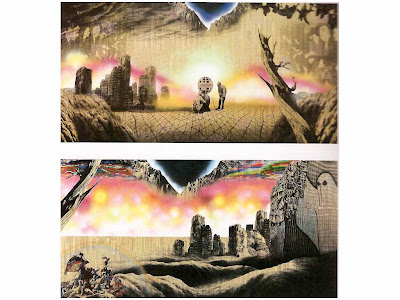
In this painting by Ged Quinn, (Here is not the Place for Nostalgia), the play of utopia, degeneration and temporality in The Time Machine are set in an arcadian landscape, in which the machine itself has been wheel clamped.

In a different register, the work 1984 and Beyond by Gerard Byrne would be appropriate. While not focusing upon Wells directly, it does address some of his successors engaged in a discussion that is definitely Wellsian. Currently on show at Tate Britain, the work uses three monitors to present a re-enactment of a round table discussion published in Playboy in 1963. The 12 participants are all well known sf authors, including Asimov, Bradbury, Clarke, who speculate on life in the year 1984.

Part of what aligns the work with Wells is a confidence in the future that seems remarkable today. Yet this confidence becomes problematised by layers of temporality that are drawn out by work.

Dominque Gonzales Foerster, who is drawn to elaborate spatial explorations of narrative, would be of interest here for a less optimistic dimension, and instead might suggest aspects of catastrophe.
Her work from (Tate Modern’s Turbine Hall in 2008/2009,) TH. 2058. does two things with its title. Firstly, it references George Lucas’s dystopian film THX1138,
Secondly, it spells out that we are in the turbine hall of tate modern in the year 2058.
Her work from (Tate Modern’s Turbine Hall in 2008/2009,) TH. 2058. does two things with its title. Firstly, it references George Lucas’s dystopian film THX1138,
Secondly, it spells out that we are in the turbine hall of tate modern in the year 2058.
The turbine hall has become a refuge, a shelter for refugees hoping to escape from an endless deluge. Also within the Turbine Hall are public sculptures, which have started to mutate, to grow, as a result of the uncanny rain.

These rows of metal bunks evoke wartime bomb shelters, refugee camps, detention centres and ambiguous forms of communal living.

And to make things more explicit, copies of science fiction novels are left upon the bare beds. Placed on one of the beds is a copy of War of the Worlds.

But I’d like to end with an artist who engages more directly with Wells.
The Canadian artist Kara Uzelman created an installation (in Sommer and Kohl gallery) in Berlin that took as its point of reference Wells’s Dr Cavor.
The Canadian artist Kara Uzelman created an installation (in Sommer and Kohl gallery) in Berlin that took as its point of reference Wells’s Dr Cavor.

The central idea here is that it is an archival excavation of the work of those influenced by Cavor. Uzelman takes Cavor as a starting point for the writing of a history of a group known as the Cavorists. According to the narrative of this work, the group continued until the scientific advancements of the twentieth century led members to realise that their goals were unachievable, and in 1994 they officially disbanded.

There are sculptures here which take the form of crude apparatuses
as well as documentation, sound and video. For the most part, this is what remains of the Cavorists’ work. The exception seems to be a tape recording of an interview with Canadian inventor John Hutchison. Hutchinson makes claims to have successfully levitated objects using what he calls Zero Point Energy.
as well as documentation, sound and video. For the most part, this is what remains of the Cavorists’ work. The exception seems to be a tape recording of an interview with Canadian inventor John Hutchison. Hutchinson makes claims to have successfully levitated objects using what he calls Zero Point Energy.

His stories are of surveillance and interference from both military and state, yet he has been unable to substantiate the claims of his success, and the recording is ultimately overwhelmed by noise. Unlike the fictional Cavorists, Hutchinson seems to be a genuine phoney.
Uzelman is drawing a very wobbly line between the different registers of fiction and actuality here, resulting in a blurring of fictional and actual influences of Wells. I am here, myself, dealing with some kind of fictionalisation, perhaps even an alternative reality in which a connection between Wells and contemporary art can be established, like that which is so evident and recognised with Ballard.
Uzelman is drawing a very wobbly line between the different registers of fiction and actuality here, resulting in a blurring of fictional and actual influences of Wells. I am here, myself, dealing with some kind of fictionalisation, perhaps even an alternative reality in which a connection between Wells and contemporary art can be established, like that which is so evident and recognised with Ballard.
It is a fantasy, but one rooted in concrete affinities. There is a shared interest in how forms of creative practice relate to the organisation of the social. Therefore, the influence of Wells on contemporary art may be less explicit than that of Ballard, but perhaps addressing this relationship is far more necessary.
Subscribe to:
Posts (Atom)